Starlink vs HughesNet 2026: Which Is Better for Rural Homes?
Disclosure: GetRemoteInternet is reader-supported. This article contains affiliate links, and we may earn a commission if you purchase through them — at no extra cost to you. Learn more.
Starlink and HughesNet are the two most talked-about satellite internet options for rural homes — but they’re built completely differently, priced differently, and suited for different situations. This comparison breaks down everything side by side so you can make the right call for your home.
Starink vs HughesNet: Quick Comparison
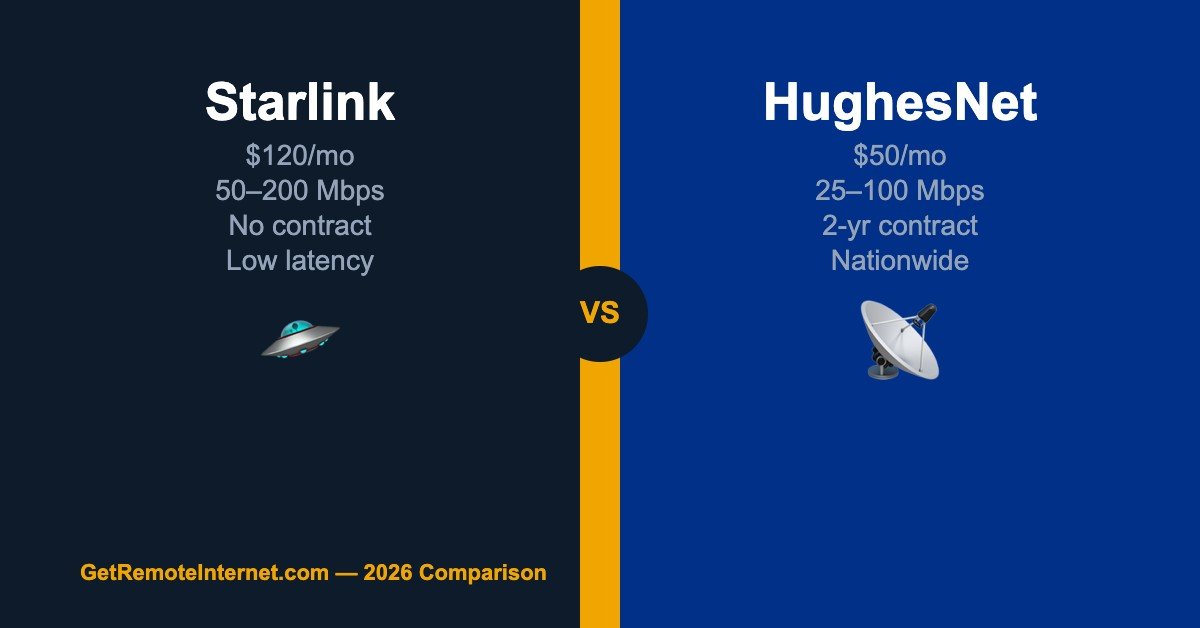
| Starlink | HughesNet | |
|---|---|---|
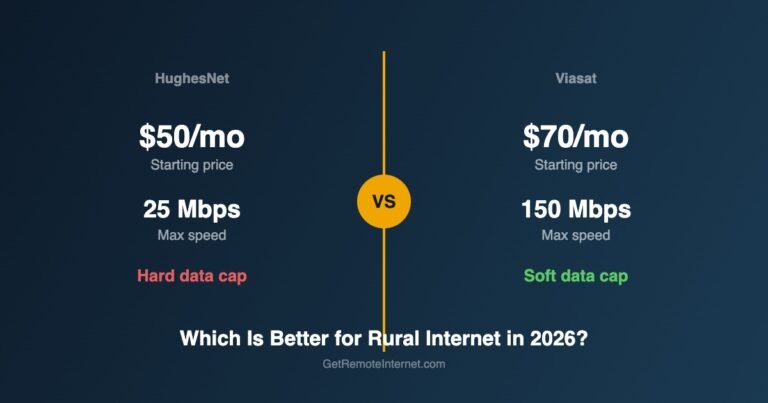
| Starting Price | $120/mo | $50/mo |
| Hardware Cost | $599 upfront | $0 (leased) |
| Download Speed | 50–200 Mbps | 25–100 Mbps |
| Latency | 20–40ms | 500–700ms |
| Data Caps | None | Soft cap (slows after limit) |
| Contract | None | 2 years |
| Availability | Most of rural US | Nationwide |
| Installation | Self-install | Professional (included) |
Speed & Performance
This is where Starlink wins decisively. Starlink uses a low-earth orbit (LEO) satellite constellation that orbits at around 550 km above Earth — close enough to deliver speeds of 50–200 Mbps with latency as low as 20–40ms. That’s fast enough for 4K streaming, video calls, online gaming, and working from home without interruption.
HughesNet operates on geostationary satellites at 35,000 km — that distance creates unavoidable latency of 500–700ms. You’ll feel it on video calls (slight delay), gaming (essentially unplayable for competitive titles), and real-time applications. However, HughesNet’s newer Fusion plans blend satellite with cellular to reduce latency to around 100ms in many areas — a meaningful improvement.
Winner: Starlink — faster speeds, dramatically lower latency.
Price & Value
HughesNet is the clear winner on upfront cost. Plans start at $50/month with no hardware purchase required — HughesNet leases the equipment and handles professional installation at no extra charge. Starlink costs $599 for hardware plus $120/month, meaning your first year costs around $2,039 total versus HughesNet’s $600 for the same period.
Over time, the gap narrows. By year 3, Starlink’s total cost ($120 × 36 + $599 = $4,919) versus HughesNet’s total ($75 × 36 = $2,700 on a mid-tier plan) still shows HughesNet cheaper — but the speed difference may make Starlink worth the premium for many households.
Winner: HughesNet — lower monthly cost, no hardware expense.
Data & Contracts
Starlink has no data caps and no contract. You pay month-to-month and can cancel anytime. That flexibility is hard to beat.
HughesNet has data thresholds — once you hit your monthly priority data limit (15GB–200GB depending on plan), speeds slow significantly during peak hours. It also requires a 2-year contract with an early termination fee of up to $400 if you cancel early.
Winner: Starlink — unlimited data, no contract.
Availability
HughesNet is available virtually everywhere in the contiguous US — if you can see the southern sky, you can get HughesNet. Starlink covers most of rural America but still has gaps, and some areas are waitlisted due to capacity limits.
If Starlink isn’t available at your address yet, HughesNet is one of the few options guaranteed to work nationwide.
Winner: HughesNet — true nationwide coverage with no waitlists.
Who Should Choose Starlink?
- You work from home and need reliable, fast speeds for video calls
- You stream 4K video or game online
- You want no data caps and no contract
- You’re willing to pay $599 upfront for better long-term performance
- Starlink is available at your address
Who Should Choose HughesNet?
- Starlink isn’t available at your address yet
- You’re on a tight budget and the $599 hardware cost is a barrier
- You use the internet mainly for browsing, email, and standard-def streaming
- You need guaranteed nationwide coverage immediately
- You’re okay with a 2-year commitment for a lower monthly rate
The Verdict
If you can afford the $599 upfront and Starlink is available at your address — get Starlink. The speed, latency, and lack of contracts make it the superior rural internet experience in 2026.
If Starlink isn’t available yet, the hardware cost is a stretch, or you need service starting today with no waitlist — HughesNet gets the job done. It’s not as fast, but it’s reliable, affordable, and available everywhere. You can always switch to Starlink later once your address becomes available.
Also worth checking: T-Mobile Home Internet at $50/month beats both on value if you have cellular coverage — no hardware cost, no contract, and speeds matching Starlink.
Frequently Asked Questions
Is Starlink faster than HughesNet?
Yes — significantly. Starlink averages 50–200 Mbps with 20–40ms latency. HughesNet averages 25–100 Mbps with 500–700ms latency. For real-world use, the latency difference is the bigger factor — Starlink feels like broadband, HughesNet feels like older satellite internet.
Can I switch from HughesNet to Starlink?
Yes, but check your HughesNet contract first. If you’re still in a 2-year term, early termination fees can reach $400. If you’re near the end of your contract — or Starlink just became available in your area — it’s worth making the switch.
Which is better for streaming — Starlink or HughesNet?
Starlink is much better for streaming. With no data caps and 50–200 Mbps speeds, you can stream 4K on multiple TVs simultaneously without buffering. HughesNet can stream HD video, but once you hit your monthly data threshold speeds slow, which can interrupt streaming during peak hours.
📡 Get Rural Internet Tips — Free
Provider updates, signal booster deals, and honest reviews delivered to your inbox.