Best Cell Phone Plans for Rural Areas 2026: Verizon, T-Mobile, AT&T Compared
Disclosure: GetRemoteInternet is reader-supported. This article contains affiliate links, and we may earn a commission if you purchase through them — at no extra cost to you. Learn more.
Rural cell coverage has improved dramatically over the last few years — but choosing the wrong carrier can still mean dead zones where you need connectivity most. This guide covers the best cell phone plans for rural areas in 2026, which carriers actually have coverage at your address, and the best hotspot devices if you want to use cellular as a backup or primary internet source.
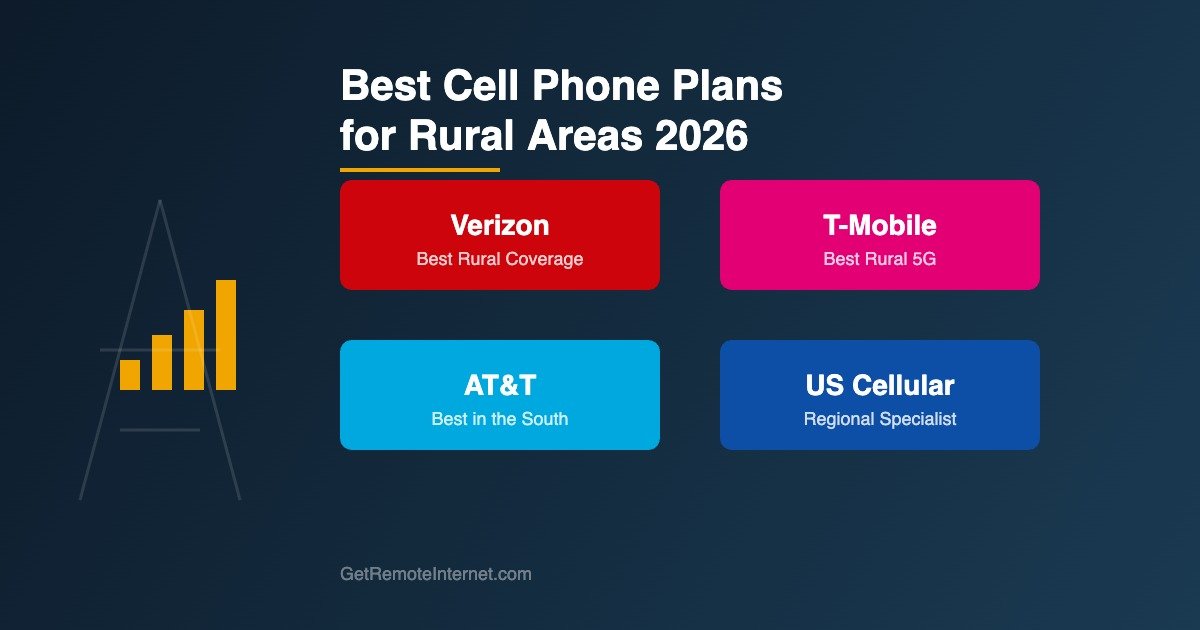
Bottom line up front: Verizon has the best rural coverage overall. T-Mobile has the fastest rural 5G where it reaches. AT&T is strong in the South and rural West. For rural-only situations, don’t rely on carrier marketing — check coverage maps at your exact address.
Rural Cell Coverage: Quick Carrier Comparison
| Carrier | Rural Coverage | Rural 5G | Best Region | Starting Price |
|---|---|---|---|---|
| Verizon | ⭐⭐⭐⭐⭐ Best overall | Moderate | Nationwide | $65/mo |
| T-Mobile | ⭐⭐⭐⭐ Strong, growing fast | Best rural 5G | Midwest, West | $50/mo |
| AT&T | ⭐⭐⭐⭐ Solid nationwide | Limited rural | South, rural West | $50/mo |
| US Cellular | ⭐⭐⭐ Regional specialist | Growing | Midwest, Southeast | $40/mo |
| Consumer Cellular | ⭐⭐⭐ Uses AT&T network | Limited | Nationwide | $20/mo |
1. Verizon — Best Rural Coverage Overall
Verizon consistently wins rural coverage comparisons. Their 850 MHz low-band spectrum penetrates buildings and terrain better than higher frequencies, and they’ve built out towers in rural areas longer than any competitor. If you live somewhere truly remote — mountains, farmland, small towns far from interstates — Verizon is most likely to have signal where others don’t.
Best Verizon Plans for Rural Users
- Unlimited Welcome: $65/mo (single line) — basic unlimited, throttled after 30GB in congested areas
- Unlimited Plus: $80/mo — 30GB premium data, mobile hotspot included (15GB), better for working remotely
- Unlimited Ultimate: $90/mo — 60GB premium data, 60GB hotspot — best if you rely on your phone as a primary hotspot
Rural-specific note: Verizon’s Extended Network roaming covers additional rural areas through agreements with smaller regional carriers. This is a meaningful advantage in states like Montana, Wyoming, and rural Appalachia where Verizon’s own towers are sparse.
Verizon Pros and Cons for Rural
✅ Best nationwide rural coverage
✅ Extended network roaming
✅ Reliable in mountainous terrain
✅ Strong building penetration
❌ Most expensive major carrier
❌ Rural 5G is limited vs T-Mobile
❌ Hotspot throttled on lower plans
2. T-Mobile — Best Rural 5G and Best Value
T-Mobile has made rural coverage their primary marketing push since acquiring Sprint, and they’ve backed it up. Their 600 MHz low-band 5G reaches farther and through more obstacles than any competitor’s 5G network. In the Midwest and rural West especially, T-Mobile’s rural reach has improved dramatically since 2022.
Best T-Mobile Plans for Rural Users
- Essentials: $50/mo — unlimited data, lower priority in congested areas
- Go5G: $65/mo — higher priority data, 15GB hotspot, good for rural remote work
- Go5G Plus: $80/mo — 50GB premium data, 50GB hotspot — best rural data plan for the price
Rural-specific note: T-Mobile also offers T-Mobile Home Internet ($50/month) as a fixed internet option if you have 5G signal at your address. It’s an incredible deal if you qualify — see our Starlink vs T-Mobile Home Internet comparison for details.
T-Mobile Pros and Cons for Rural
✅ Best rural 5G speeds where available
✅ Most affordable unlimited plans
✅ Large and growing rural footprint
✅ $50/mo Home Internet if available
❌ Still gaps in very remote areas
❌ Lower priority than Verizon on LTE
❌ Building penetration varies
3. AT&T — Best for the Rural South and West
AT&T’s rural coverage is strongest in the South (Texas, Oklahoma, Arkansas, the Gulf states) and parts of the rural West where they’ve invested heavily in FirstNet — the nationwide public safety broadband network that AT&T built and manages. FirstNet uses dedicated spectrum that prioritizes first responders, but the infrastructure benefits everyone on the AT&T network in rural areas.
Best AT&T Plans for Rural Users
- Unlimited Starter: $50/mo — basic unlimited, no hotspot included
- Unlimited Extra: $65/mo — 50GB premium data, 15GB hotspot
- Unlimited Premium: $75/mo — 75GB premium data, 60GB hotspot, best for remote workers
AT&T Pros and Cons for Rural
✅ Strong rural South and West coverage
✅ FirstNet infrastructure investment
✅ Good LTE fallback in 5G gaps
✅ Competitive pricing vs Verizon
❌ Weaker than Verizon in rural Midwest/Northeast
❌ Rural 5G limited
❌ Coverage gaps in mountain West
4. US Cellular — The Rural Specialist
US Cellular is a regional carrier that specifically targets rural markets in the Midwest, Southeast, and Pacific Northwest. They’re not nationwide, but in their coverage areas they often match or beat the big three for rural signal quality. If you live in Iowa, Wisconsin, Maine, Oregon, or parts of the Carolinas, US Cellular is worth checking.
- Unlimited Basic: $40/mo — good entry price for solid rural coverage in their footprint
- Unlimited Plus: $55/mo — adds mobile hotspot and higher data priority
Check uscellular.com/coverage first — if they cover your area, they’re worth serious consideration over the national carriers.
5. Consumer Cellular — Best Budget Option for Light Rural Users
Consumer Cellular uses the AT&T network (with some T-Mobile roaming) and offers lower prices for lighter data users. Starting at $20/month, it’s the best option if you mostly need calls and texts with occasional data, and you’re in an area with solid AT&T coverage.
Not recommended for: Remote work, heavy streaming, or areas where AT&T coverage is marginal. Consumer Cellular deprioritizes data behind AT&T’s own subscribers, which matters more in rural congested areas.
How to Check Coverage at Your Exact Address
Carrier coverage maps are optimistic — they show theoretical coverage, not real-world performance at your specific property. Here’s how to actually verify before you switch:
- Check each carrier’s official map at your address: verizon.com/coverage, t-mobile.com/coverage, att.com/maps/wireless-coverage-map.html
- Ask neighbors what carrier they use and whether they’re happy — real-world data beats any map
- Request a trial SIM — T-Mobile offers a free 3-month trial. Verizon and AT&T allow returns within 30 days. Use this before committing to a 12-month plan.
- Check OpenSignal or RootMetrics for crowdsourced rural coverage data in your county
- Test at the property, not the nearest town — coverage maps often show strong signal in town that drops to nothing a mile down a rural road
Best Cellular Hotspot Devices for Rural Internet
If you want to use cellular as a primary or backup internet connection, a dedicated hotspot device performs much better than using your phone as a hotspot. Dedicated hotspots have better antennas, support external antenna connections, and don’t drain your phone battery.
Netgear Nighthawk M6 — Best Overall Rural Hotspot
The M6 supports 5G Sub-6 bands used by all three major carriers, connects up to 32 devices, and has an external antenna port — critical for rural use where you may need to add a cellular signal booster. Battery lasts 13 hours. Works with Verizon, AT&T, and T-Mobile.
GL.iNet Spitz AX (GL-X3000) — Best for Technical Users
The Spitz AX is a cellular router rather than a portable hotspot — it plugs in like a home router and uses a SIM card for its WAN connection. It supports dual SIM (for failover between carriers), has external antenna ports, runs OpenWrt for advanced configuration, and delivers WiFi 6 speeds. The best option if you’re setting up cellular as a primary rural internet connection.
Pair Your Hotspot With a Cell Signal Booster
In rural areas with weak cellular signal, a hotspot alone may struggle. A cell signal booster amplifies the existing signal from the nearest tower, dramatically improving speeds and reliability for both your phone and any hotspot devices. See our full guide to the best cell signal boosters for rural homes.
Should You Use Cellular as Your Primary Rural Internet?
Cellular internet (via hotspot or cellular router) can work as a primary internet source in rural areas, but it comes with real limitations:
- Data caps: Even “unlimited” plans throttle hotspot data after 15–60GB depending on your plan. A household streaming Netflix and working from home can easily burn through 60GB in a week.
- Congestion: Rural towers serve fewer users but also have less capacity. During evenings when neighbors are home, speeds can drop significantly.
- Latency: LTE latency (30–70ms) is good. 5G can be even lower. Both are much better than satellite internet for video calls and gaming.
- Cost: Unlimited hotspot plans with high data thresholds cost $80–$150/month — comparable to Starlink but with data restrictions.
Best strategy for most rural homes: Use Starlink or fixed wireless as your primary internet, and keep a cellular plan as backup for outages. A $50/month T-Mobile line with 50GB hotspot data covers most emergencies and work-from-home situations when your primary internet goes down.
📡 Get Rural Internet Tips — Free
Provider updates, signal booster deals, and honest reviews delivered to your inbox.
Frequently Asked Questions
Which carrier has the best rural coverage in the US?
Verizon covers the most rural geography overall. T-Mobile has the fastest rural 5G where available. The best carrier for your specific location depends entirely on which towers are nearest your property — check coverage maps at your exact address rather than relying on general rankings.
Can I use my cell phone as internet for my rural home?
Yes, but hotspot data limits are the bottleneck. Most unlimited plans include 15–60GB of hotspot data before throttling. A family household typically needs 150–300GB per month for normal streaming and browsing — you’ll exceed hotspot limits quickly. A dedicated cellular router with a high-data SIM plan works better for primary internet use.
Is T-Mobile Home Internet better than a cellular hotspot?
Yes, significantly. T-Mobile Home Internet is $50/month with truly unlimited data and no hotspot throttling. It uses the same towers as T-Mobile’s phone network but with a dedicated gateway device optimized for home use. If T-Mobile Home Internet is available at your address, it’s almost always a better deal than paying for a hotspot plan. See our full comparison here.
Do signal boosters work with any carrier?
Most consumer signal boosters (weBoost, SureCall, HiBoost) are carrier-agnostic — they amplify all cellular frequencies simultaneously, so they work with Verizon, AT&T, T-Mobile, and any MVNO using those networks. The one exception is Cel-Fi boosters, which are single-carrier only but provide much higher gain for that one network.
What’s the cheapest rural cell phone plan?
Consumer Cellular starts at $20/month on the AT&T network. Mint Mobile (T-Mobile network) offers plans from $15/month if you pay annually. These budget options work well in areas with good AT&T or T-Mobile coverage, but in truly rural areas with marginal signal, spending more for Verizon’s better rural infrastructure often makes sense.