Starlink vs Viasat 2026: Which Satellite Internet Is Better for Rural Homes?
Disclosure: GetRemoteInternet is reader-supported. This article contains affiliate links, and we may earn a commission if you purchase through them — at no extra cost to you. Learn more.
Starlink and Viasat are both satellite internet providers serving rural America — but they work completely differently and suit different budgets and needs. Starlink uses cutting-edge low-earth orbit technology; Viasat is a proven geostationary system with wider guaranteed coverage. Here’s how they compare in 2026.
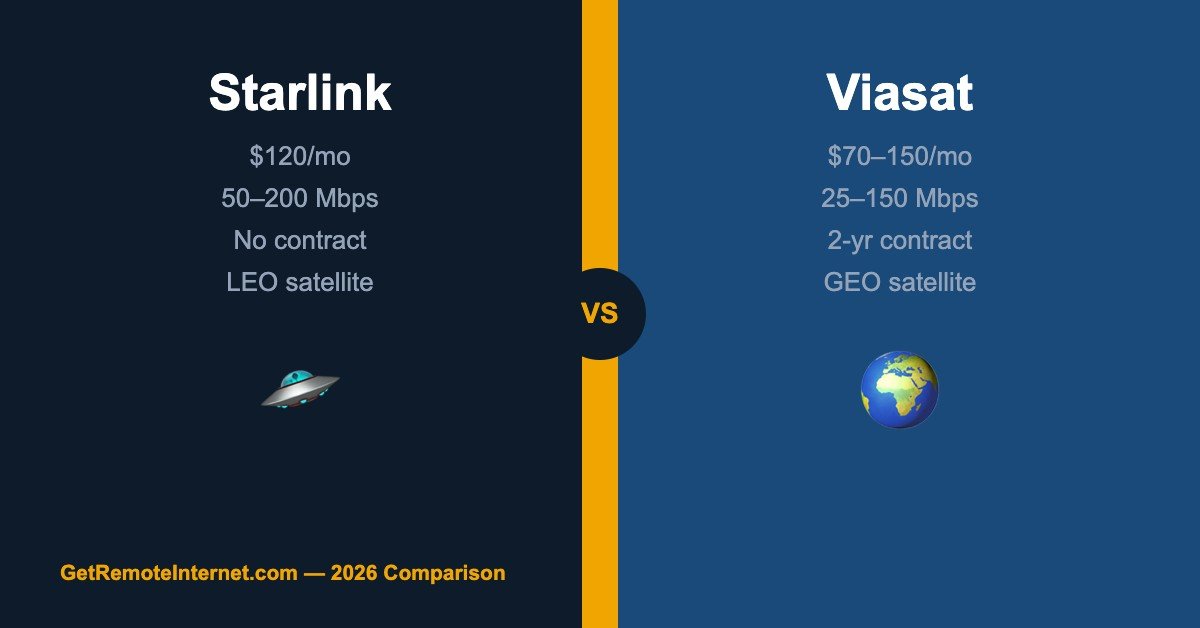
Starlink vs Viasat: Quick Comparison
| Starlink | Viasat | |
|---|---|---|
| Starting Price | $120/mo | $70/mo |
| Hardware Cost | $599 upfront | $0 (professional install) |
| Download Speed | 50–200 Mbps | 25–150 Mbps |
| Latency | 20–40ms | 500–800ms |
| Data | Unlimited, no caps | Priority data threshold, then slows |
| Contract | None | 2 years |
| Availability | Most of rural US | Near-nationwide |
| Satellite Type | LEO (550 km up) | GEO (35,000 km up) |
Speed & Latency
Starlink’s low-earth orbit satellites deliver 50–200 Mbps with latency of just 20–40ms — comparable to cable internet. Viasat’s geostationary satellites sit 35,000 km away, creating latency of 500–800ms regardless of plan tier. That delay is barely noticeable for browsing and streaming, but it makes video calls laggy and online gaming nearly impossible on Viasat.
Viasat’s ViaSat-3 satellite (launched 2023) improved capacity significantly, with some users seeing 100–150 Mbps on higher-tier plans. But the latency limitation is physics — geostationary satellites will always have high latency no matter the speed.
Winner: Starlink — faster speeds and dramatically lower latency.
Price & Upfront Cost
Viasat wins on upfront cost. Plans start at $70/month with professional installation included and no equipment to purchase. Starlink costs $599 for hardware plus $120/month — a higher barrier to entry, especially for households watching their budget.
Over a 2-year period: Starlink costs approximately $3,479 ($599 hardware + $120 × 24). Viasat on a mid-tier plan runs approximately $2,400–$3,600 depending on the plan chosen. They’re closer in total cost than the monthly prices suggest.
Winner: Viasat — lower upfront cost and comparable total cost over 2 years.
Data & Contracts
Starlink has no data caps and no contract — cancel anytime. Viasat uses priority data thresholds: once you exceed your plan’s priority data allowance, speeds slow during peak network hours (though service continues). Viasat also requires a 2-year contract with early termination fees.
Winner: Starlink — unlimited data, month-to-month flexibility.
Availability & Installation
Viasat covers virtually all of rural America — if you can see the southern sky, Viasat can reach you. Starlink covers most of rural US but still has waitlisted areas and occasional coverage gaps. Viasat also includes professional installation at no extra charge, while Starlink is self-install.
Winner: Viasat — wider guaranteed coverage, professional installation included.
Who Should Choose Starlink?
- You work from home and need low-latency video calls
- You stream 4K, game online, or use real-time applications
- You want no data caps and no annual contract
- You can absorb the $599 upfront hardware cost
- Starlink is available at your address without a long waitlist
Who Should Choose Viasat?
- Starlink isn’t available at your address or has a long waitlist
- You want professional installation with no upfront hardware cost
- Your use is primarily browsing, email, and standard streaming
- You’re in an extremely remote area guaranteed to have Viasat coverage
The Verdict
Starlink is the better product in 2026 — faster, lower latency, no caps, no contract. If it’s available at your address and you can handle the $599 hardware cost, it wins.
Viasat is the right choice when Starlink isn’t an option — it’s reliable, widely available, and gets the job done for everyday internet use without any upfront equipment cost. Also worth checking: T-Mobile Home Internet at $50/month beats both on value if you have cellular coverage.
Frequently Asked Questions
Is Starlink faster than Viasat?
Yes — Starlink is faster and has far lower latency (20–40ms vs 500–800ms). The latency difference matters most for video calls, gaming, and real-time applications.
Can I switch from Viasat to Starlink?
Yes, but check your Viasat contract first. If you’re mid-contract, early termination fees can reach $500. Time your switch for when your Viasat contract ends, or when the ETF is low enough that Starlink’s superior service justifies paying it.
Which is better for rural streaming — Starlink or Viasat?
Starlink is better for streaming. No data thresholds means you can stream as much as you want in 4K without speeds slowing. Viasat can stream HD video, but heavy users will hit priority data limits and experience slowdowns during peak hours.
📡 Get Rural Internet Tips — Free
Provider updates, signal booster deals, and honest reviews delivered to your inbox.