Best Starlink Alternatives 2026: What to Try When Starlink Isn’t an Option
Disclosure: GetRemoteInternet is reader-supported. This article contains affiliate links, and we may earn a commission if you purchase through them — at no extra cost to you. Learn more.
Starlink changed everything for rural internet — but it’s not the right fit for everyone. Maybe it’s not available in your area yet. Maybe $120/month plus a $599 dish is out of budget. Or maybe trees, terrain, or a restrictive HOA are getting in the way.
The good news: there are solid Starlink alternatives in 2026 that can get you connected — some faster, some cheaper, and some with no equipment cost at all.
Quick Comparison: Best Starlink Alternatives
| Provider | Starting Price | Speed | Contract | Best For |
|---|---|---|---|---|
| T-Mobile Home Internet | $50/mo | 72–245 Mbps | None | No-contract flexibility |
| Viasat | $70/mo | 25–150 Mbps | 2 years | Wide rural coverage |
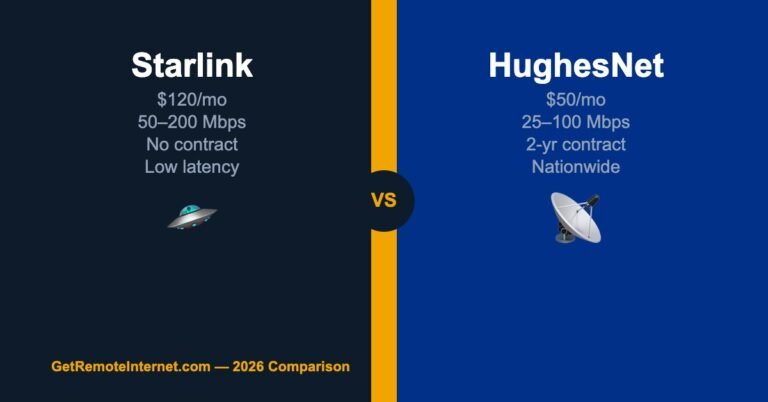
| HughesNet | $50/mo | 25–100 Mbps | 2 years | Lowest price nationwide |
| AT&T Fixed Wireless | $55/mo | 10–25 Mbps | None | Reliable where available |
| CenturyLink/Quantum Fiber | $50/mo | 200 Mbps–1 Gbps | None | Wired speed, some rural areas |
1. T-Mobile Home Internet — Best No-Contract Option
T-Mobile Home Internet is the most popular Starlink alternative for rural homes, and it’s easy to see why. At $50/month with no annual contract, no data caps, and no equipment fees, it’s hard to beat on value. T-Mobile ships you a small plug-in gateway — no technician required — and you’re up in minutes.
Real-world speeds typically range from 72 to 245 Mbps depending on your area and tower congestion. That’s more than enough for HD streaming, video calls, remote work, and online gaming. During peak hours in dense rural areas, speeds can dip — but for most households it performs reliably.
Pros: No contract, no install fee, plug-and-play setup, solid speeds, $50/mo flat
Cons: Requires T-Mobile 5G/LTE coverage, can slow during congestion, no wired backup
2. Viasat — Best for Wide Rural Coverage
Viasat covers virtually all of rural America through geostationary satellites, making it one of the most widely available options on this list. If T-Mobile doesn’t reach your property and Starlink has a waitlist, Viasat is often the next call to make.
Plans start at $70/month and go up to $150/month for faster speeds and higher data allowances. Viasat launched its new ViaSat-3 Americas satellite in 2023, which significantly improved capacity and reliability. Expect speeds of 25–150 Mbps depending on your plan and location.
One downside: Viasat uses data thresholds. Once you hit your plan’s data priority limit, speeds can slow during network congestion — though they don’t cut off your service entirely.
Pros: Near-nationwide coverage, improving speeds, professional installation included
Cons: 2-year contract, data thresholds, higher latency than Starlink or T-Mobile
3. HughesNet — Most Affordable Nationwide Satellite
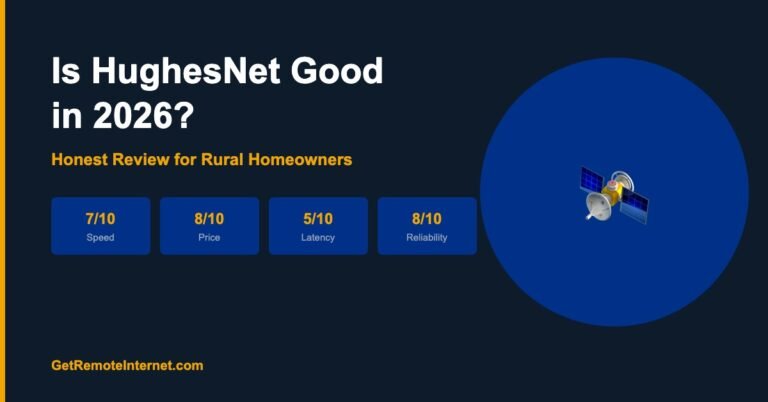
HughesNet has been connecting rural homes for decades and remains one of the most affordable satellite internet options in the country. Their Fusion plans — which blend satellite and cellular signals — have dramatically improved latency and real-world performance compared to older plans.
Plans start at $50/month for 15GB of priority data, with higher tiers available up to 200GB. Speeds run 25–100 Mbps on most plans. Like Viasat, HughesNet operates on geostationary satellites, so you’ll see higher latency (500–700ms) than Starlink or T-Mobile — but for browsing, streaming, and email it’s perfectly functional.
Pros: Nationwide availability, affordable entry price, no hard data cutoffs
Cons: 2-year contract with early termination fee, higher latency, speeds slow after priority data
4. AT&T Fixed Wireless — Best Where It’s Available
AT&T Fixed Wireless Access brings reliable wireless broadband to rural homes using AT&T’s cellular towers — no satellite dish required. Where it’s available, it’s one of the most dependable options on this list, with no data caps, no annual contract, and speeds of 10–25 Mbps that are more than enough for most households.
The catch: availability is limited. AT&T Fixed Wireless is only offered in specific rural service areas, so you’ll need to check their address tool to see if you qualify. If you do, it’s an excellent value at $55/month.
Pros: No data caps, no contract, reliable, affordable, no dish required
Cons: Very limited availability, lower speeds than Starlink or T-Mobile
5. CenturyLink / Quantum Fiber — Best Wired Option for Rural Areas
CenturyLink — now rebranding as Quantum Fiber in many markets — is the underdog on this list. It’s a wired DSL or fiber connection, which means no weather disruptions, consistent speeds, and low latency. Where available in rural areas, it’s often the best overall value you can find.
Plans start at $50/month with no data caps, and fiber service can reach 200 Mbps to 1 Gbps where infrastructure exists. DSL-only areas will see slower speeds (10–100 Mbps), but the reliability and latency of a wired connection still beat satellite for most use cases.
Not available everywhere — check their site to see if service extends to your address. If it does, seriously consider it over satellite.
Pros: No data caps, consistent speeds, low latency, no contract on most plans
Cons: Limited rural footprint, DSL speeds can be slow in remote areas
Which Starlink Alternative Should You Choose?
Here’s a quick decision guide based on your situation:
- No contract, best value → T-Mobile Home Internet (if you have coverage)
- Widest rural satellite coverage → Viasat
- Lowest monthly cost → HughesNet
- Reliable, no data caps → AT&T Fixed Wireless (if it’s available at your address)
- Best wired option → CenturyLink / Quantum Fiber (if it reaches your area)
- Still want Starlink? → Join the Starlink waitlist — availability expands regularly
If you’re in a truly remote area with no cellular coverage and no wired infrastructure, Viasat or HughesNet are your most reliable options. If you have any T-Mobile LTE or 5G signal at your home — even weak — T-Mobile Home Internet is worth trying first given its low price and no-contract terms.
If I Could Only Recommend One Alternative
Strip away the comparison tables and here’s my honest pick: if you have any T-Mobile signal at the house, try T-Mobile Home Internet first. Not because it’s the fastest — Starlink usually wins there — but because at $50/month with no contract and no equipment to buy, the downside of trying it is basically zero. Worst case, you send the gateway back. I tell every neighbor the same thing: try T-Mobile, and if it’s flaky at your spot, then spend the $599 on Starlink.
When an “Alternative” Actually Beats Starlink
People assume Starlink is automatically the best and everything else is a compromise. That’s not always true:
- Local fixed wireless from a fiber-fed WISP often beats Starlink on latency and price — if there’s a tower near you.
- You barely use the internet? HughesNet at $50 does email and light browsing for less than half of Starlink’s monthly.
- You move around (RV, two homes)? A hotspot or T-Mobile’s flexibility beats babysitting a fixed dish.
Match the tool to how you actually live, not to the hype.
Before You Switch, Check These Three Things
- Re-check Starlink availability — it may have opened up since you last looked.
- Test your cell signal in dBm, not bars, at the exact spot the gateway would sit. Bars lie; dBm doesn’t.
- Read the contract length. The cheap satellite plans lock you in for two years with a real cancellation fee.
Frequently Asked Questions
Is Starlink still the best rural internet option in 2026?
For many rural homes, yes — Starlink offers the best combination of speed, latency, and availability. But at $120/month plus equipment costs, it’s not for everyone. T-Mobile Home Internet at $50/month is a compelling alternative for most users who have coverage.
Can I use T-Mobile Home Internet if I already have T-Mobile cell service?
Yes — and T-Mobile sometimes offers existing customers discounts on Home Internet. Check their site for bundle pricing. The Home Internet gateway is a separate device from your phone, so it won’t interfere with your cellular plan.
What’s the cheapest rural internet option with no contract?
T-Mobile Home Internet at $50/month with no annual contract is the best value no-contract rural internet option in 2026. AT&T Fixed Wireless ($55/month, no contract) is a close second where available. Both include unlimited data.
Does bad weather affect these alternatives the same way it does Starlink?
Viasat and HughesNet are also satellite-based, so heavy rain and snow can temporarily affect performance — though both are generally less affected than Starlink during storms because their geostationary satellites don’t move. T-Mobile and AT&T Fixed Wireless use cellular towers and are typically more weather-resistant. CenturyLink/Quantum Fiber as a wired connection is the most weather-stable option of all.
📡 Get Rural Internet Tips — Free
Provider updates, signal booster deals, and honest reviews delivered to your inbox.