HughesNet vs Viasat 2026: Which Satellite Internet Is Better for Rural Areas?
Disclosure: GetRemoteInternet is reader-supported. This article contains affiliate links, and we may earn a commission if you purchase through them — at no extra cost to you. Learn more.
If Starlink isn’t available at your address — or the $120/month price is out of reach — HughesNet and Viasat are the two most widely available satellite internet options for rural America. Both reach virtually anywhere with a clear sky view. But they’re very different products, and choosing the wrong one is an expensive mistake. This guide breaks down every major difference so you can pick the right one for your situation.
Bottom line up front: Viasat offers faster speeds and more flexible plans, but costs more. HughesNet is cheaper and more predictable, but slower and more restrictive. Neither comes close to Starlink on speed — but both are solid options when Starlink isn’t available or affordable.
HughesNet vs Viasat: Quick Comparison
| Feature | HughesNet | Viasat |
|---|---|---|
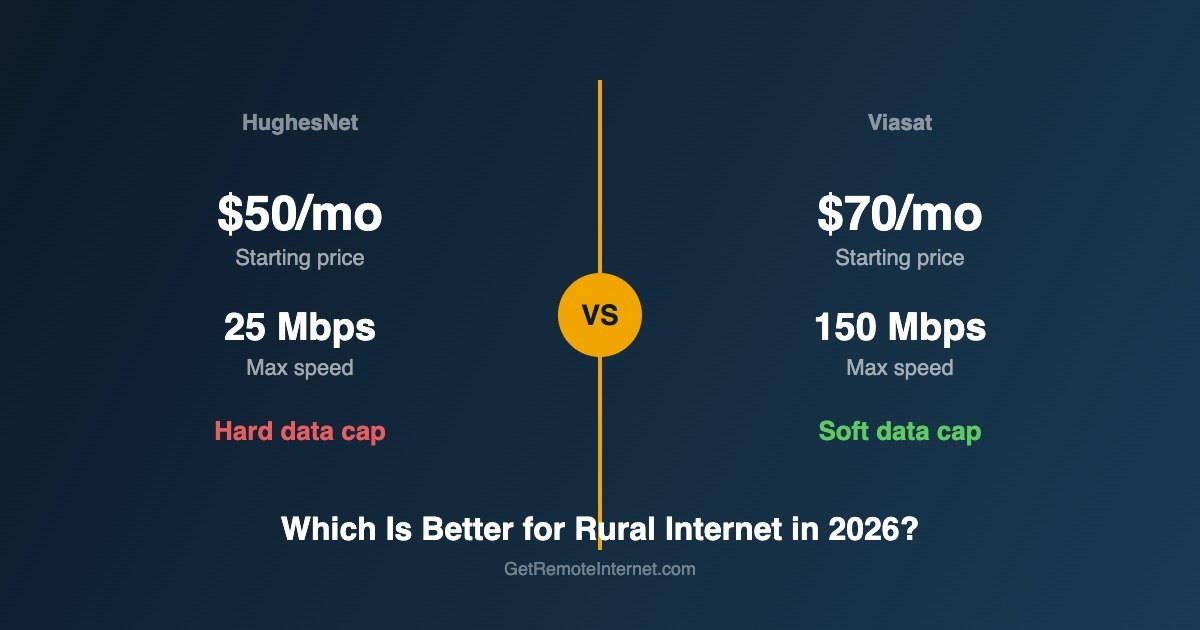
| Starting Price | $50/mo | $70/mo |
| Max Advertised Speed | 25 Mbps down | Up to 150 Mbps down |
| Typical Real-World Speed | 15–20 Mbps | 25–50 Mbps |
| Data Caps | Yes (hard throttle after cap) | Yes (soft throttle) |
| Latency | 600–700ms | 600–800ms |
| Contract | 24 months | 24 months |
| Equipment Fee | $15/mo lease or $450 buy | $13/mo lease or $300–$500 buy |
| Installation | Professional (included) | Professional (included) |
| Availability | Nationwide US | Nationwide US |
Pricing: HughesNet Is Cheaper, But Read the Fine Print
HughesNet Plans (2026)
- Select: $50/mo — 15GB data, 25 Mbps
- Elite: $75/mo — 30GB data, 25 Mbps
- Elite+: $100/mo — 75GB data, 25 Mbps
- Fusion: $130/mo — 75GB data + cellular hybrid, faster performance
HughesNet’s pricing looks attractive until you realize the data caps are tight. Once you hit your monthly cap, speeds drop to 1–3 Mbps — barely enough to load a webpage. You can buy extra data tokens at $3/GB, which gets expensive fast.
One bright spot: HughesNet offers free data between 2–8 AM. If you schedule large downloads overnight, you can stretch your plan significantly.
Viasat Plans (2026)
- Unlimited Bronze 25: $70/mo — 25 Mbps, soft data cap
- Unlimited Silver 25: $100/mo — 25 Mbps, more priority data
- Unlimited Gold 50: $150/mo — 50 Mbps
- Unlimited Platinum 100: $200/mo — 100 Mbps
Viasat uses “soft” data caps — after you hit your priority data allowance, speeds slow down but don’t grind to a halt like HughesNet. You can still browse and stream at reduced speeds. This is a meaningful real-world advantage.
Watch out for: Viasat’s advertised speeds are only available in certain beam areas. Actual speeds vary significantly by location — check what’s available at your specific address before signing up.
Speed: Viasat Wins, But Location Determines Everything
HughesNet caps all plans at 25 Mbps download — there’s no higher tier available regardless of what you pay. In practice, most users see 15–20 Mbps on a good day.
Viasat’s higher plans advertise up to 100–150 Mbps, but real-world speeds depend heavily on which satellite beam covers your area and how congested it is during peak hours. Many rural users on Viasat report 25–50 Mbps consistently, with some seeing much higher.
For everyday use: Both are fast enough for video calls, HD streaming on one or two devices, and working from home on basic tasks. Where they differ is when multiple people are using the internet simultaneously — Viasat handles multi-device households better.
Latency: Both Are High — And That’s a Real Problem
This is the biggest shared weakness of both providers. Geostationary satellites sit 22,000 miles above Earth, and that distance adds unavoidable delay to every data request.
- HughesNet latency: 600–700ms typical
- Viasat latency: 600–800ms typical
- Starlink latency: 20–50ms (low Earth orbit)
- Cable/fiber latency: 5–20ms
What does this mean in practice? Video calls work, but feel slightly laggy. Online gaming (first-person shooters, real-time strategy) is frustrating to unplayable. Web browsing feels slow because every page load requires multiple round trips at 600ms each. Video streaming buffers more than you’d expect even with decent speeds.
If latency is a concern, Starlink is the only satellite option with acceptable latency. Both HughesNet and Viasat are comparable to each other on this front — high latency is a satellite physics problem, not a provider problem.
Data Caps: Viasat’s Soft Cap Beats HughesNet’s Hard Cutoff
This is where the two providers differ most meaningfully in day-to-day experience.
HughesNet hard cap: When you hit your monthly data allowance, speeds drop to 1–3 Mbps until your cycle resets. At that speed, streaming is impossible, video calls fail, and even basic web browsing is painful. The only escape is buying data tokens ($3/GB) or waiting for the free overnight window.
Viasat soft cap: Once you exceed your priority data, speeds reduce — but to a usable level (typically 5–10 Mbps). You can still stream standard definition video, make video calls, and browse normally. It’s not great, but it’s livable.
How much data do you need?
- Netflix HD streaming: ~3GB/hour
- Zoom video call: ~1GB/hour
- Basic browsing + email: 1–2GB/day
- A family of 4 with normal usage: 150–300GB/month
By those numbers, HughesNet’s entry-level 15GB plan covers less than a week of normal family use. Even the 75GB plan runs out in about 3 weeks. Viasat’s plans generally offer more priority data and the soft cap means you’re not completely cut off.
Reliability and Weather Performance
Both HughesNet and Viasat are geostationary satellite services, so they share the same weather vulnerabilities:
- Heavy rain: Signal degradation and brief outages during severe storms
- Snow on dish: Most newer dishes have heating elements; older installs may need manual clearing
- Clouds and light rain: Minimal impact
- Wind: No signal impact, though physical dish damage is possible in extreme wind
Because their satellites are much higher than Starlink, HughesNet and Viasat actually experience more rain fade than Starlink. The signal has to travel through more atmosphere, giving rain more opportunity to absorb it.
Contracts and Early Termination
Both providers require a 24-month contract — a significant commitment. Early termination fees apply if you cancel:
- HughesNet ETF: $400 minus $17 for each completed month
- Viasat ETF: $15 per remaining month (up to $360)
Read the contract carefully before signing. Both companies have a reputation for difficult cancellation processes. If Starlink becomes available in your area during your contract, you’ll have to pay to exit.
Who Should Choose HughesNet?
- You’re on a tight budget and $50/month is the ceiling
- You’re a light internet user (email, basic browsing, occasional streaming)
- You’re a single person or couple without heavy simultaneous usage
- You can discipline yourself to use the 2–8 AM free data window for large downloads
- You just need reliable connectivity for work emails and video calls — not entertainment
Who Should Choose Viasat?
- You need more speed and your location supports Viasat’s higher-tier plans
- You have a family or multiple devices streaming simultaneously
- You work from home and need consistent performance throughout the day
- You can afford $100–$150/month for a better experience
- You hate the idea of being completely cut off after hitting a data cap
Should You Consider Starlink Instead?
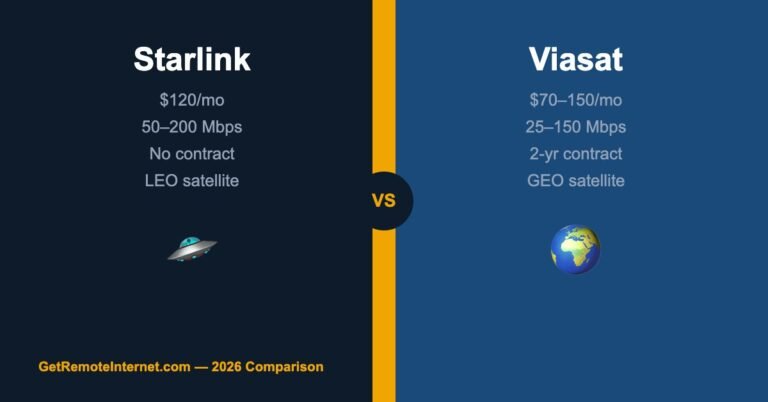
Before committing to either HughesNet or Viasat, check Starlink availability at your address. Starlink costs $120/month with a $599 equipment fee — more upfront, but significantly better performance: no data caps, 50–200 Mbps speeds, and 20–50ms latency instead of 600ms+.
If Starlink is available, it’s worth the premium for most rural households. HughesNet and Viasat make the most sense when Starlink has a waitlist in your area, or when the upfront $599 hardware cost isn’t feasible.
Frequently Asked Questions
Is HughesNet or Viasat better for streaming?
Viasat is better for streaming. Its higher speed tiers and soft data cap mean you’re less likely to run out of usable data mid-month. HughesNet’s hard cutoff at 1–3 Mbps makes streaming impossible once you hit your cap.
Can I game online with HughesNet or Viasat?
Not really. The 600–800ms latency makes real-time online gaming (shooters, MOBAs, fighting games) unplayable. Turn-based games, strategy games, and games that don’t require split-second reactions are fine. Neither provider is a gaming solution — Starlink is the only satellite option with gaming-acceptable latency.
Does HughesNet or Viasat work in all 50 states?
Both are available in all 50 US states including Alaska and Hawaii. Coverage is nationwide by definition — geostationary satellites cover the entire continental US and beyond from a single orbital position.
Which has better customer service — HughesNet or Viasat?
Neither has a strong reputation for customer service. Both score below average in consumer satisfaction surveys. Viasat edges out HughesNet slightly in most reviews, but complaints about billing, contract cancellation, and technical support are common with both providers. Read recent reviews on your state’s specific service area before committing.
What happens if I move during my contract?
Both providers allow service transfers to a new address in most cases — satellite internet covers everywhere, so you can typically take your equipment and plan with you. Contact your provider before moving to confirm availability and transfer process. Early termination fees still apply if you cancel entirely.
📡 Get Rural Internet Tips — Free
Provider updates, signal booster deals, and honest reviews delivered to your inbox.